As an early open-source model, ChatGPT is a frequent first-use tool, but panelists and attendees suggested various other tools that use artificial intelligence:
- Perplexity, an "answer engine" that cites its sources
- Claude, for research
- Google’s NotebookLM and Gemini, for research and other tasks
- Nano Banana, for image editing
- Prezi, for presentations
- Fireflies, for meeting transcriptions
- Microsoft’s Copilot, for a variety of tasks
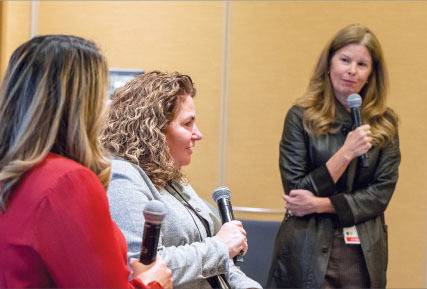
Paige Mullis of MMI Textiles (right) led a panel discussion on business uses of artificial intelligence that included interaction with the audience as well. Panelists were Xochil Herrera Scheer of The Chicago Pattern Maker and Mary Reardon, also of MMI.
Presenters encourage attendees to try AI
Adam Penner, AP Consulting and Technical Services, spoke on the topic "AI for All: Practical Tools to Streamline Your Business" and offered a "hands-on starting point" to enter the world of artificial intelligence (AI).
"It’s not the future," Penner says. "It’s the present, and it’s here." AI can make daily activities more convenient, taking over busywork so humans can focus on more creative and meaningful tasks. He started with ChatGPT, an AI tool that can help with various work-related tasks.
He’s used it for constructing the basic terms for an estimate from "rough notes," including adding "anything I might forget," he says.
No need to take meeting notes; AI can record and transcribe them for you. It can also improve the language you use in email messages, which is especially important if you’re upset, he says. ChatGPT will correct it, "so the anger doesn’t come through."
AI is getting easier to use, too, as it is now built into tools we already use, such as Google Workspace and Microsoft 365, and it has user-friendly interfaces that respond to natural language prompts. "If you can text, you can use AI," he says.
There are some risks. He warns of overreliance and using AI for expert advice. "It’s not a lawyer or an engineer," he says. It’s also important to remember that "anything you put in there could end up somewhere else." Creators of AI tools say their enterprise versions allow for more data privacy; check the terms.
The best way to get to know AI is to just try it. "Play with it," he says. "There’s no better substitute for learning it."
Audience, panelists share ideas on using AI
In a panel discussion during the Emerging Technologies Conference, the audience actively participated concerning "AI in Everyday Business," with Paige Mullis, senior sales executive at MMI Textiles, moderating.
Panelist Xochil Herrera Scheer, who works independently in patternmaking and product development through her company, The Chicago Pattern Maker, says she first used it for taking notes and "started experimenting with software for patternmaking."
Panelist Mary Reardon, vice president textile innovation, MMI, says she uses ChatGPT to reword messages and find information. "In the past it was a Google search, but AI is so much faster."
Audience members came up with their own suggestions. Jonathan Crumpler, who presented earlier in the day about developing augmented reality training, advises, "Don’t struggle against it; use it."
Herrera Scheer says AI is a great tool to make changes in design, such as color, or generating marketing or website copy. However, it’s necessary to edit, "when the copy sounds like AI, not like a real person."
Should you keep the memory on when using AI? Half of the people at this session indicated that they do. Herrera Scheer says, "The more you work with it, the more it remembers you, and the better it will work for you."
However, material will recycle, so Reardon adds, "It’s trained to know what you like to hear, so if you keep ‘hearing yourself,’ turn off the memory and prompt again."
There is also a sustainability issue due to the amount of energy AI consumes. "It’s something to consider before using [AI], if you don’t really need to," Herrera Scheer says.
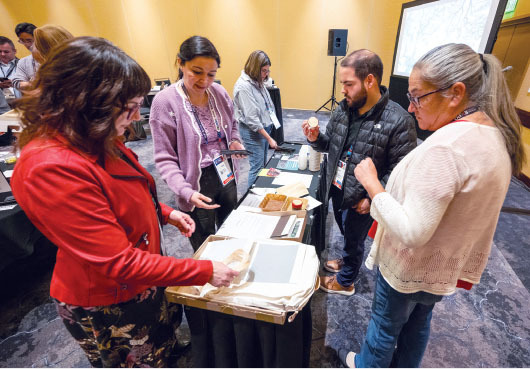 Emerging Technologies Conference attendees got a firsthand look at a variety of biomaterials now available from industry providers such as BIOFUR®, Bananatex® Hemplyte™ nanocellulose, Circ® lyocell, and Elevate vegan leather.
Biomaterial give value to waste products
The growth of biomaterials (fibers and fabrics) has been well documented in this publication. Emerging Technologies Conference presenter Thomasine Dolan Dow takes it a step further and calls it "a revolution" in next-generation fibers, materials and coatings.
In her presentation she also argued for "giving value to waste" by "transforming overlooked, discarded byproducts into something valuable." This could include waste from agriculture, plants, food and textiles.
Bio-based is "nature-based," she says, consisting of materials "that can be grown again and again," such as corn, potatoes, sugarcane, soybeans and grains. Emerging next-gen feedstocks include mycelium, agricultural waste, seaweed, kelp and algae, with market growth well underway. In 2023, the global vegan leather market was valued at $73.4 billion by market research firm Next Move Strategy Consulting. The forecast for 2030 is slightly more than $139 billion.
Dow urges everyone to consider the environmental impact of our choices. Currently, 60% of apparel is made from fossil fuel-based materials (polyester, nylon and acrylic), which can shed microplastics that do not biodegrade.
"It’s really hard to compete with polyester and with plastic in general because it’s so cheap—and it’s been subsidized," she says.
However, there are many companies with biosynthetic materials and biofibers on the market.
"Biosynthetics are particularly intriguing," she says. "They could eventually replace petroleumbased plastics and nylon."
She also listed many recycling companies and provided a substantial list of companies making performance bio-coatings and dyes, which are "really important," she says, "Because once you put a petroleum coating on, you can’t recycle it."
Infrared-responsive textile introduced
Akira Kumada, SOLAMENT™ product manager for Takisada-Nagoya Co. Ltd., spoke on the company’s infrared-responsive textile. Made with metal-derived nanoscale particles, the material is capable of absorbing near-infrared (NIR) energy when applied to almost any textile.
The technology was invented by Sumitomo Metal Mining Co. Ltd. and has been "widely utilized for heat-blocking for years," Kumada says. What’s new is the process that made it possible to disperse the product into a yarn matrix.
Sunlight, he points out, is 52% visible light, 6% ultraviolet light, and the rest—42%—is NIR light, which SOLAMENT can capture and absorb. One test under simulated sunlight showed heat reduction of about 19% with SOLAMENT’s infused fibers. The fibers without SOLAMENT cooled about 6%.
The infused fabric can also be used for keeping people warm. "Yes, this can do both [heat and cool]," Kumada says. "It depends on the structure of the weave." The product absorbs the heat and can contain it, disperse it from the wearer or release it toward the body.
Microplastics testing, standards, laws still nascent
Although testing to quantify and characterize microplastics is still in its developmental stages, interest in it is on the rise, especially among textile producers, says Danielle Harrier, Ph.D., with Exponent, an engineering and scientific consulting firm with offices worldwide. Harrier is a senior associate in the Polymer Science and Materials Chemistry Group at the company’s office in Menlo Park, Calif.
Over the past few years, several standards have been developed—and others are still emerging—for analyzing the composition and quantity of microplastics in water, including some standards that are specific to textiles. The challenge is that no single piece of equipment or technique will take care of the entire size range of particles, she says. Her firm uses a combination of techniques.
Research is influencing policymakers. "Textiles are being looked at [by legislators] with increasing scrutiny," Harrier says.
The only federal ban currently in effect targets plastic microbeads used in cosmetics, such as exfoliating face washes. However, a shift is beginning, she says, as state and federal lawmakers work to address the broader issue of plastic pollution. Most existing laws, bills, regulations and proposals focus on primary microplastics, like microbeads, but are increasingly referencing secondary sources such as synthetic textiles. Emerging regulations aim to curb microfiber pollution by requiring washing machines to include particle filters.
The original article, published in the Specialty Fabrics Review, can be found
HERE.